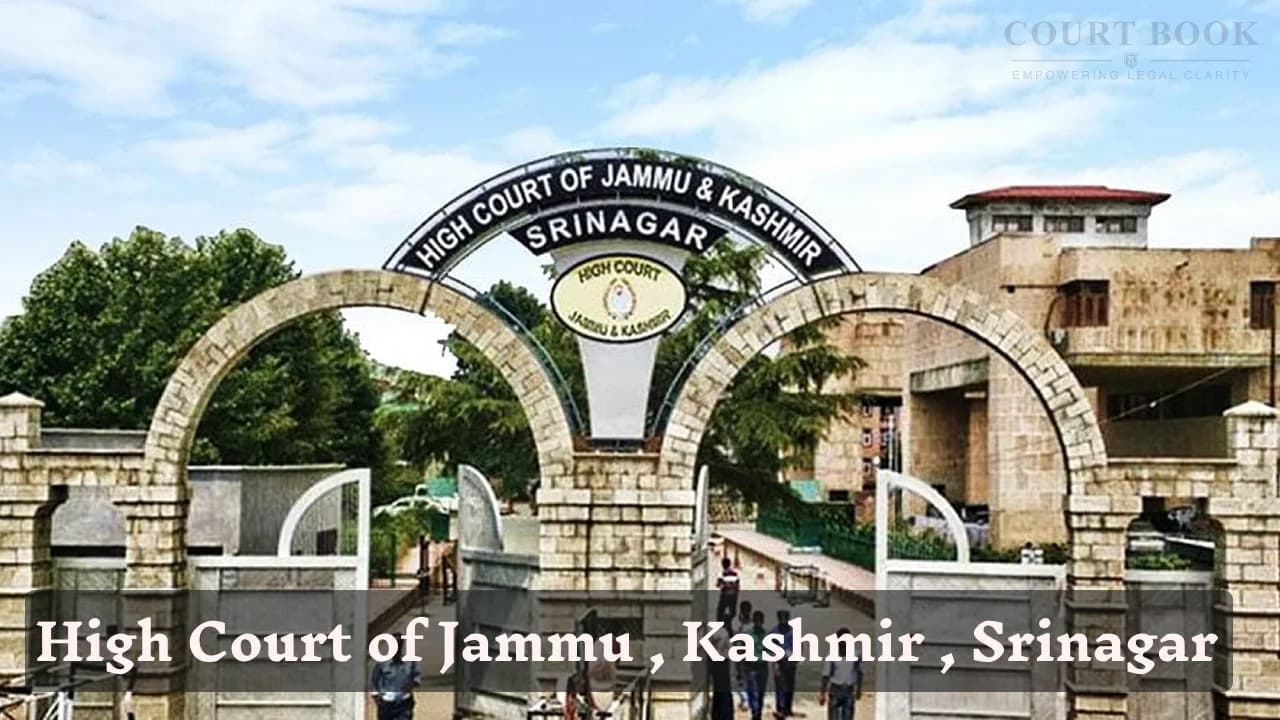
A routine cheque bounce dispute from central Kashmir took an unexpected legal turn this week, prompting the High Court of Jammu & Kashmir and Ladakh at Srinagar to intervene. Sitting in Court Justice Sanjay Dhar made it clear that trial courts cannot stretch their role beyond what the law permits, especially after parties have settled their dispute.
The case arose from warrants issued against a businessman even though a compromise had already been recorded. The High Court was not amused, and its order brings much-needed clarity for similar cases pending across trial courts.
Read also:- Delhi High Court Ends Criminal Case Over Family Land Mutation: Cheating, Forgery Charges Found Unsustainable
Background
The matter stemmed from a complaint filed under Section 138 of the Negotiable Instruments Act - the provision that deals with cheque bounce cases. The complainant alleged that Sajjad Ahmad Malik had issued a cheque of ₹17.18 lakh which was dishonoured.
During the proceedings before the Additional Special Mobile Magistrate at Beerwah, both sides chose to settle. A compromise deed dated 15 October 2024 was placed on record. Under this settlement, Malik agreed to pay ₹5 lakh by October 2025, ₹3 lakh by cheque in November 2025, and the remaining amount in monthly instalments of ₹1.50 lakh.
Read also:- Unnao Rape Case Reaches Supreme Court Again as Plea Challenges Delhi High Court’s Suspension
Statements of both parties supporting the compromise were recorded by the trial court on 6 November 2024. Normally, that should have been the end of the criminal case, at least on paper.
But things did not move in the usual way.
Court’s Observations
Instead of disposing of the cheque bounce complaint in terms of the settlement, the trial Magistrate continued to keep the case alive. Worse, when payments did not come through as scheduled, warrants were issued against the accused.
This approach did not find favour with the High Court.
Justice Dhar noted that once a compromise is accepted in a cheque bounce case, the trial court’s role is limited. “The proper course for the learned trial Magistrate should have been to dispose of the complaint in terms of the compromise,” the bench observed.
The High Court explained this in simple terms: a criminal court cannot act like a recovery agent. Monitoring instalments or enforcing payment terms is not part of its job. If the accused defaults after a settlement, the complainant has a separate remedy - filing execution proceedings to recover money, similar to enforcing a civil decree.
The order further clarified that, only at that stage, the court could use legal tools like Section 421 of the Criminal Procedure Code, which allows recovery of fines or money. Acting as an “executing court” during the pendency of a criminal complaint, however, was termed legally incorrect.
Read also:- Delhi High Court Ends Criminal Case Over Family Land Mutation: Cheating, Forgery Charges Found Unsustainable
“The procedure adopted by the learned trial Magistrate is not in accordance with law,” the court plainly stated.
Decision
Setting aside the approach taken by the trial court, the High Court disposed of the petition and directed the Magistrate to proceed strictly in the manner laid down by law - first dispose of the complaint on compromise, and only then allow recovery proceedings if required. A copy of the order was also directed to be sent to the trial court for compliance.
Case Title: Sajad Ahmad Malik vs Gulzar Ahmad Wani
Case Number: CRM(M) No. 826/2025 (with CrlM Nos. 2086/2025 & 2087/2025)
Case Type: Criminal Petition (Cheque Bounce / Section 138 Negotiable Instruments Act)
Decision Date: 26 December 2025