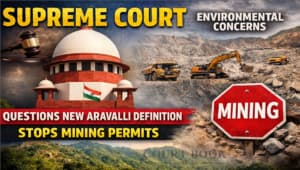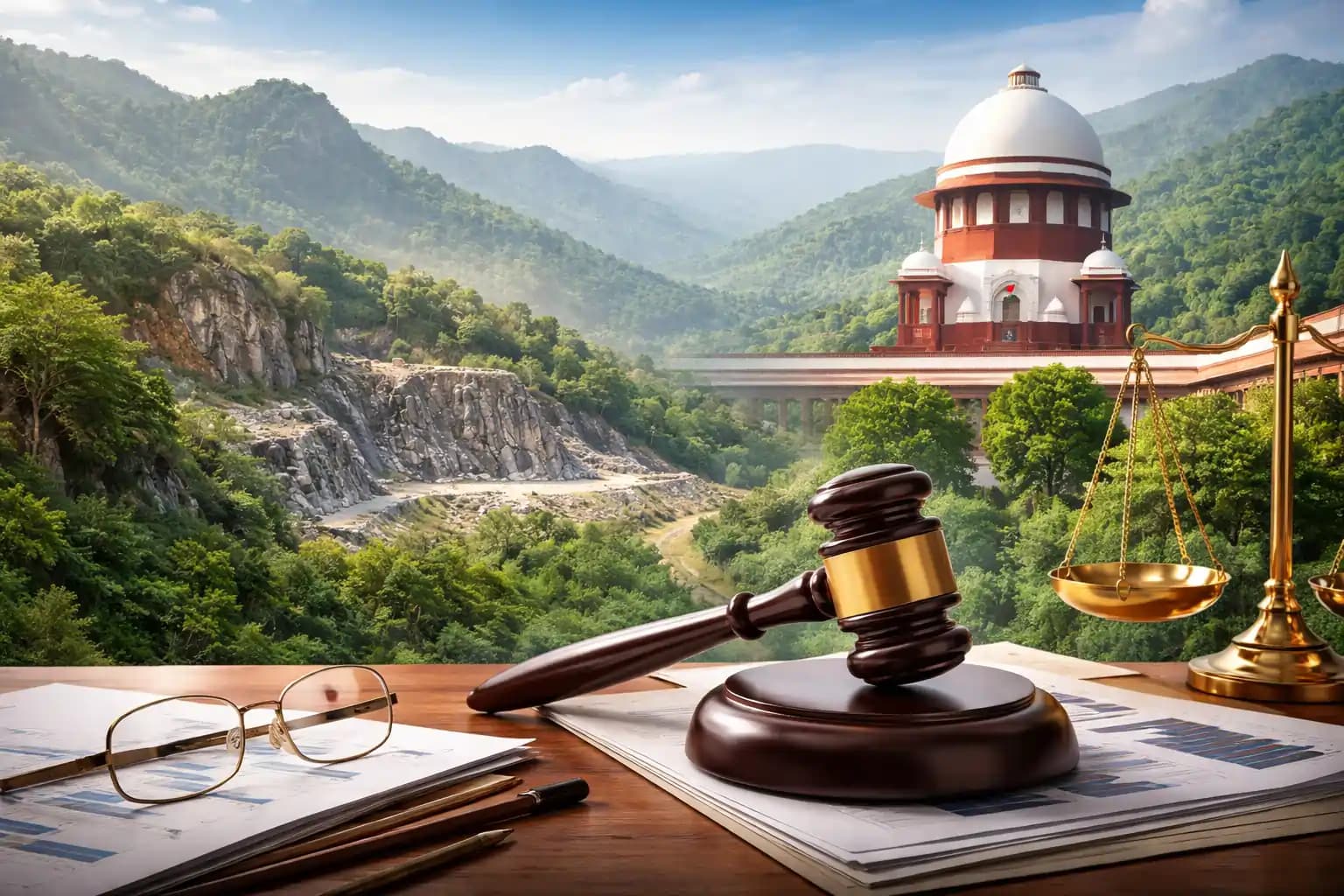
Inside Court No. 1 on Monday, the atmosphere was serious and cautious. The Supreme Court took up a suo motu case that goes to the heart of environmental protection in North-Western India - the definition of the Aravalli Hills and the future of mining activities there.
Calling the Aravallis the “green lungs” of the region, the court made it clear that ecological protection cannot be decided on unclear or loosely framed definitions. By the end of the hearing, the bench pressed pause on its own earlier directions and ordered a fresh, independent expert review.
Read also:- Supreme Court Backs Merit in Court Jobs: Reserved Candidates Can't Be Shut Out of Open Category
Background of the Case
The matter arises from Suo Motu Writ Petition (Civil) No. 10 of 2025, initiated to address long-standing confusion over how the Aravalli Hills and Ranges should be officially defined.
For years, different states - Delhi, Haryana, Rajasthan, and Gujarat - followed different standards. This lack of uniformity created space for unchecked mining, deforestation, and urban expansion.
In May 2024, the Supreme Court directed the formation of a high-level committee under the Ministry of Environment, Forest and Climate Change (MoEF&CC) to propose a single, uniform definition. The committee submitted its report in October 2025, recommending an elevation-based definition and suggesting a ban on new mining leases in newly identified Aravalli areas.
Read also:- Bombay High Court Rules CIDCO Agreement Was Only a License, Quashes ₹26 Lakh Stamp Duty Demand
The court accepted this definition and issued detailed directions on 20 November 2025. However, that judgment soon triggered multiple applications raising concerns over gaps, ambiguities, and unintended consequences.
Court’s Observations
Hearing the matter on 29 December 2025, the vacation bench of the Supreme Court of India, led by the Chief Justice, acknowledged that serious questions had surfaced after the earlier ruling.
The bench observed that while the committee’s work was technical, certain aspects needed deeper scrutiny.
“There appears to be a genuine concern that the adopted definition may unintentionally exclude ecologically connected areas,” the court noted.
One key issue flagged was the 500-metre proximity rule, which defines an Aravalli Range only when two hills are located within that distance. The court questioned whether this narrow framing could leave large, continuous ecological zones outside protection.
Read also:- Big Relief for Wife: Allahabad High Court Orders Maintenance From Application Date
Another concern related to public claims that only a small fraction of Rajasthan’s hills meet the 100-metre elevation threshold, potentially stripping protection from lower hillocks that still form part of the Aravalli ecosystem.
The bench also pointed out that neither the committee report nor the earlier judgment clearly addressed whether mining could continue in gaps between hills that are ecologically connected but technically excluded.
Decision of the Court
After considering the concerns, the Supreme Court took a cautious step.
The court ordered the constitution of a new High-Powered Expert Committee, comprising independent domain specialists, to conduct a comprehensive and impartial review. This committee will examine ecological continuity, mining impacts, excluded areas, and long-term environmental consequences.
Read also:- Delhi High Court Cuts Interim Maintenance to ₹25,000; Says Father Cannot “Shirk Responsibility”
Crucially, the bench directed that:
- The committee’s earlier recommendations,
- And the Supreme Court’s judgment dated 20 November 2025,
shall remain in abeyance until the fresh expert exercise reaches a logical conclusion.
“This pause is necessary to ensure that no irreversible ecological or administrative action is taken,” the bench said.
At the same time, the court reiterated its earlier protective stance. Until further orders, no mining permissions - new or renewed - shall be granted in the Aravalli Hills and Ranges, as defined in the Forest Survey of India’s 2010 report, without the court’s prior approval.
Read also:- Allahabad High Court Flags Caveat Lapses at Board of Revenue, Issues Fairness Guidelines
The matter has been listed before the Green Bench, with notices issued to the Union government and the four concerned states. Senior law officers and the Central Empowered Committee have also been asked to assist the court.
Case Title: In Re: Definition of Aravalli Hills and Ranges and Ancillary Issues
Case No.: Suo Motu Writ Petition (Civil) No. 10 of 2025
Case Type: Public Interest Litigation (Environmental)
Decision Date: 29 December 2025