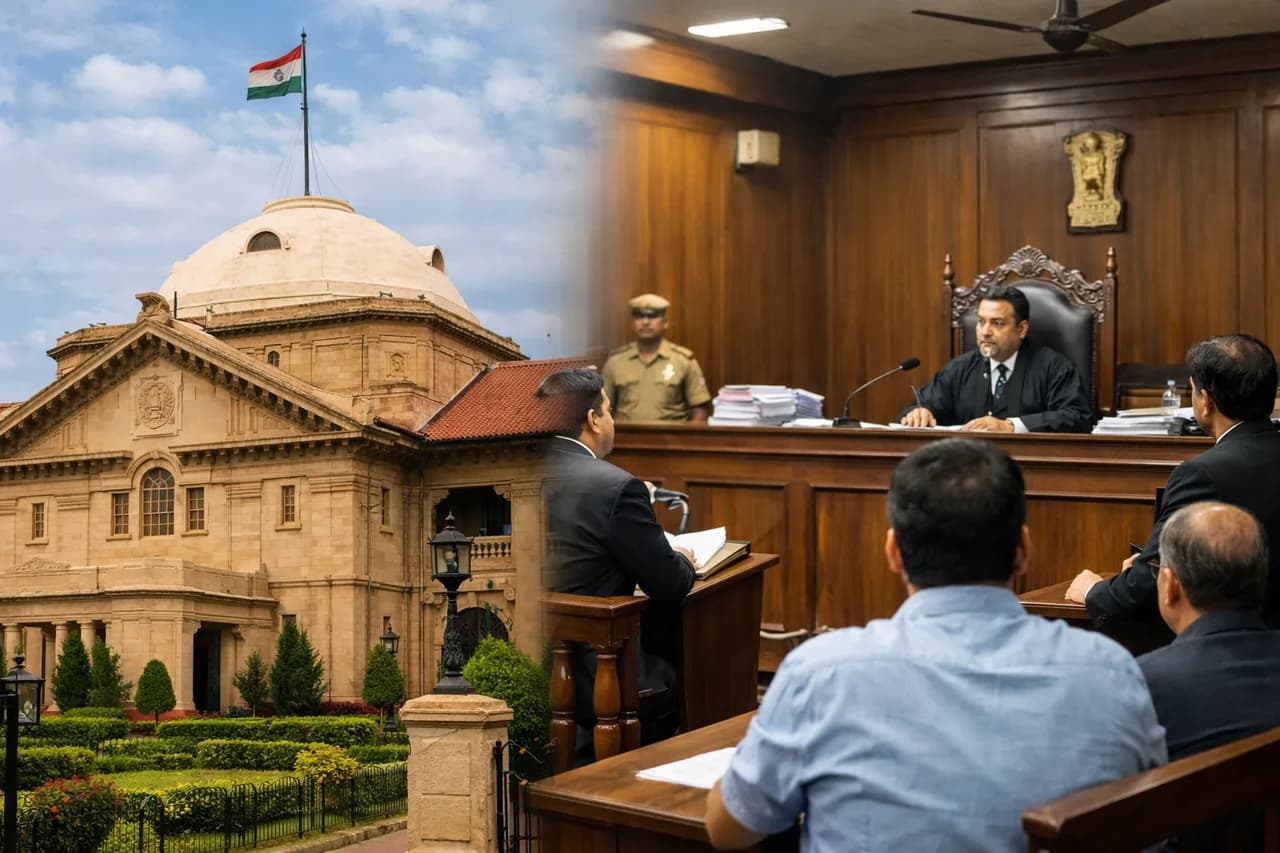
The Allahabad High Court (Lucknow Bench) has delivered a clear ruling on election law, holding that delays in filing municipal election petitions cannot be excused under the Limitation Act. The court set aside both the condonation of delay and the final order that had unseated an elected Nagar Panchayat chairperson, restoring the original election result.
Background of the Case
The dispute arose from the election for the post of Chairperson, Nagar Panchayat Ashrafpur Kichhauncha, in Ambedkar Nagar district. Polling took place on May 11, 2023, and results were declared on May 13, with Omkar Gupta emerging as the winning candidate.
Read also:- Patna High Court Orders NIOS to Correct Student’s Marksheet After Record Error
An election petition challenging his victory was filed on July 18, 2023-well beyond the 30-day limit prescribed under Section 20 of the U.P. Municipalities Act, 1916. The election petitioner later sought condonation of a 17-day delay, citing court vacations and late receipt of information.
The trial court allowed this request under Section 5 of the Limitation Act and eventually allowed the election petition itself, leading to Gupta’s removal and appointment of an administrator.
The High Court examined a narrow but crucial issue: Can the delay in filing an election petition under the U.P. Municipalities Act be condoned using Section 5 of the Limitation Act?
Counsel for the elected chairperson argued that election laws are strict and self-contained, leaving no scope for condoning delay. The State and opposing counsel countered that a District Judge acts as a “court,” allowing application of the Limitation Act.
Court Observation
Justice Subhash Vidyarthi first clarified that while a District Judge deciding an election petition does act as a court, that fact alone does not make Section 5 applicable.
The bench noted that election laws are special statutes with fixed timelines. “When the legislature has consciously provided a specific limitation period and applied only selected provisions of the Limitation Act, others cannot be read into it,” the court observed.
Referring to several Supreme Court judgments, the High Court reiterated that election petitions stand on a different footing from ordinary civil proceedings. The judge stressed that strict adherence to timelines is essential to maintain certainty in the democratic process.
Read also:- High Court Refuses to Quash FIR Against Advocate Rajat Kalsan Over Alleged Caste-Based Speech
Why Section 5 Does Not Apply
The court pointed out three decisive reasons:
- Election petitions are governed by a special law that prescribes a fixed time limit.
- The Municipalities Act expressly applies only Section 12(2) of the Limitation Act, not Section 5.
- Section 5 does not apply to original proceedings like election petitions, even if they follow civil procedure in trial.
Quoting settled law, the bench underlined that courts cannot extend limitation periods in election matters on equitable grounds.
Final Decision
Allowing the writ petition, the High Court set aside the order condoning delay as well as the judgment that had invalidated the election. The election petition itself was dismissed as time-barred.
“All necessary consequences shall follow,” the court said, adding that the administrative order appointing an administrator automatically stood nullified. As a result, Omkar Gupta was held entitled to continue as Chairperson of the Nagar Panchayat.
Case Title: Omkar Gupta vs State of Uttar Pradesh & Others
Case No.: Writ – C No. 11631 of 2025
Case Type: Municipal Election Dispute
Decision Date: December 3, 2025